 Skip to main content


Australian businesses have more payment processing options than ever before, making it important to choose a solution that meets their operational needs. Ensuring that you select the right payment solution is crucial for operational efficiency, customer satisfaction, and ultimately, your bottom line.
Two of the primary solutions at your disposal are EFTPOS and POS systems. Understanding the distinctive characteristics and benefits of each can significantly impact your decision-making process and business outcomes. In this discussion, we will explore the intricacies of both solutions, drawing comparisons to help you determine the optimal strategy for your business needs.
Introduction
Australia’s retail and service sectors have undergone a significant transformation over the years, adapting to new technological advancements in payment solutions. Gone are the days when cash was king; today, electronic payment systems dominate, providing both speed and convenience. As a business owner in Australia, you have access to a range of payment systems tailored to diverse business requirements and client preferences.
The landscape includes everything from traditional card swipe machines to advanced cloud-based solutions that integrate with inventory management and customer relationship management systems. Understanding the difference between EFTPOS (Electronic Funds Transfer at Point Of Sale) solutions and Point of Sale (POS) systems can help you harness these technologies effectively to streamline transactions, enhance customer experience, and drive growth.
What Is an EFTPOS Solution?
EFTPOS, which stands for Electronic Funds Transfer at Point Of Sale, is an electronic payment system widely used in Australia. As a business, when you use an EFTPOS solutions, you allow customers to pay for goods and services using electronic payment methods, including credit and debit cards.
EFTPOS terminals are typically standalone machines dedicated solely to processing card payments. They are ideal for businesses that need a straightforward solution to handle high volumes of transactions requiring fast processing times. One of the chief advantages of EFTPOS is its simplicity and reliability, ensuring your business can efficiently process transactions without extensive downtime or errors.
Moreover, EFTPOS systems are supported by major financial institutions and service providers in Australia, offering robust security features to protect customer data. They also support contactless payments, allowing customers to pay using contactless cards, smartphones, and digital wallets.
What Is a POS System?
A POS (Point of Sale) system, on the other hand, is a more comprehensive solution that extends beyond mere payment processing. While EFTPOS focuses primarily on executing card transactions, a POS system is an all-encompassing setup that combines hardware and software tools to perform various retail tasks and operations.
POS systems can process sales, track inventory, generate reports, and provide valuable business insights. For instance, with a POS system, your business can monitor stock levels in real-time, streamline the ordering process, and even predict inventory needs based on historical data. Furthermore, POS software solutions can integrate seamlessly with accounting systems, CRM platforms, and e-commerce applications, providing a unified approach to business management.
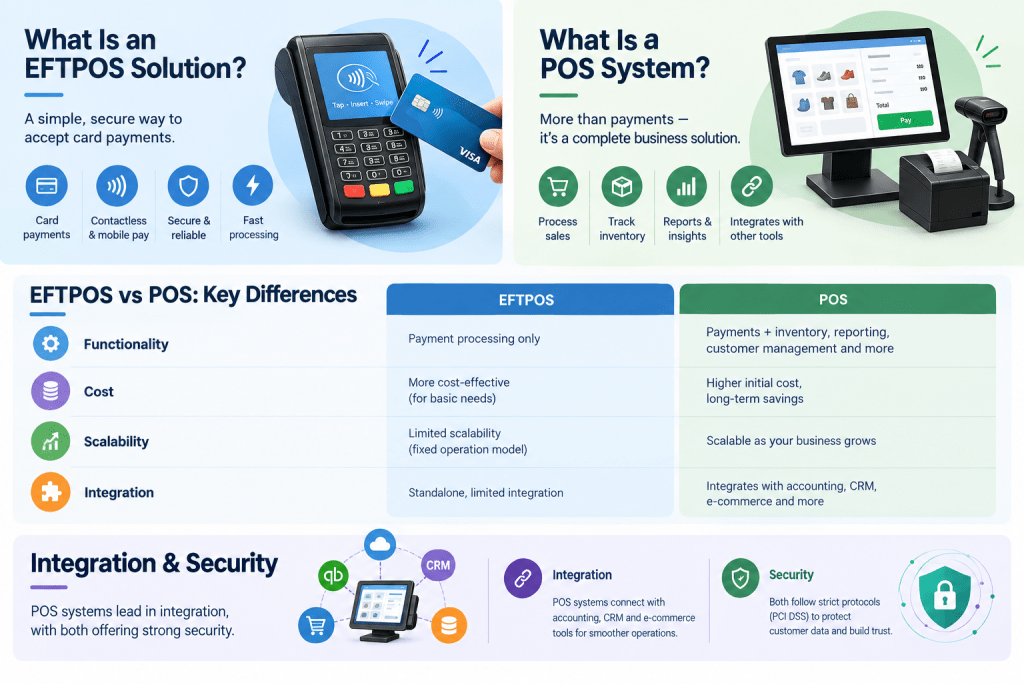
As a result, POS systems are ideally suited for businesses looking for more than a way to accept payments. By choosing a POS system, you gain insights into efficiency improvements, sales strategies, and customer engagement approaches.
EFTPOS vs POS: Key Differences
Now that you understand the basic functionality of EFTPOS and POS systems, it’s essential to identify their key differences to better ascertain which suits your business needs.
- Functionality: EFTPOS systems are focused on processing electronic card payments, while POS systems offer a broader range of functionalities, including inventory management and sales reporting.
- Cost: EFTPOS solutions are typically more cost-effective for small businesses that only require basic payment processing capabilities. Conversely, POS systems, due to their advanced features, might need a higher initial investment but provide cost savings through integrated business operations.
- Scalability: POS systems often come equipped with scalable features allowing for expansion as the business grows. EFTPOS tends to be less adaptable, suitable for businesses with a fixed operation model without anticipated growth.
- Integration: POS systems can integrate with other business software, providing a comprehensive solution. EFTPOS primarily serves as a standalone payment processing tool with limited integration capabilities.
Integration and Security
One of the most crucial aspects of choosing a payment solution in today’s digital age is considering the integration capabilities and security measures. Both EFTPOS and POS systems offer varying degrees of integration; however, POS systems take a distinct lead in this area.
POS systems facilitate seamless integration with various business applications, from accounting interfaces to customer relationship management software. This synergy not only enhances efficiency but also minimises the risk of data discrepancies as information is shared across platforms.
In terms of security, both EFTPOS and POS systems follow stringent protocols to safeguard sensitive card and personal data. This protection is crucial in maintaining customer trust and compliance with Australian regulations, such as the Payment Card Industry Data Security Standards (PCI DSS). As technology continues to evolve, the future of payment solutions will likely focus extensively on enhancing security measures further to guard against sophisticated cyber threats.
Choosing the Right Payment Solution
Selecting the right payment solution for your business requires a careful consideration of your specific needs, industry dynamics, and customer preferences. Here are some factors to keep in mind:
- Business Size: Smaller businesses may benefit from the simplicity and cost-effectiveness of EFTPOS solutions, whereas larger businesses, especially those with multiple locations or an e-commerce component, could leverage the robust capabilities of POS systems.
- Transaction Volume: High volume environments, like retail stores with constant foot traffic, may prefer the speed of EFTPOS machines. However, if comprehensive data insights are essential, POS systems are the better choice.
- Budget: Assess both the initial investment and long-term savings. POS systems might require a substantial upfront cost but can lead to savings via improved efficiencies in inventory and customer relations management.
- Future Growth: If you anticipate growth, consider a POS system with scalable functionalities to accommodate future expansion without needing a complete overhaul.
Conclusion
Choosing between EFTPOS and POS solutions involves an understanding of your business objectives, operational needs, and customer expectations. Consider the strengths, limitations, and costs of each option to find the best fit for your business. With the rapid pace of technological advancements, staying informed about emerging trends and new capabilities is crucial for maximizing your payment solution’s potential.
Ultimately, the decision you make should facilitate smooth operations, enhance customer satisfaction, and contribute positively to your bottom line. Whether opting for the streamlined efficiency of an EFTPOS system or the broad functionality of a POS system, the right choice will propel your business competitiveness in Australia’s dynamic marketplace.
Frequently Asked Questions (FAQs)
1. What is the difference between an EFTPOS solution and a POS system?
An EFTPOS solution is designed primarily to process electronic card payments, while a POS system offers additional business management features such as inventory tracking, sales reporting, customer management, and software integrations. Businesses that need more than payment processing often benefit from a POS system.
2. Which is better for small businesses in Australia: EFTPOS or POS?
It depends on your business requirements. EFTPOS solutions are ideal for businesses that need a simple and cost-effective way to accept card payments. A POS system is better suited to businesses that require inventory management, reporting, and other operational tools.
3. Can an EFTPOS terminal be integrated with a POS system?
Yes. Many modern POS systems integrate with EFTPOS terminals, allowing businesses to process payments while automatically updating sales records, inventory, and customer information.
4. Are EFTPOS and POS systems secure?
Yes. Both EFTPOS and POS systems use security measures such as encryption and PCI DSS compliance to protect payment information. Many solutions also support secure authentication and fraud prevention features to safeguard customer data.
5. How do I choose the right payment solution for my business?
When choosing between an EFTPOS solution and a POS system, consider your business size, transaction volume, budget, future growth plans, and the features you need. Selecting a solution that aligns with your operational requirements can help improve efficiency and deliver a better customer experience.